
As we step into January 2026, central government employees and pensioners across India are buzzing with anticipation. The 7th Central Pay Commission (CPC), which has governed salaries, allowances, and pensions since 2016, officially completes its 10-year cycle on December 31, 2025.
This paves the way for the 8th Pay Commission, a long-awaited revision aimed at aligning public sector compensation with rising inflation, economic realities, and living costs.
While no immediate salary jumps will hit bank accounts on January 1, 2026, the stage is set for significant long-term benefits. Let’s break down what we know so far about this landmark change.
What Is the 8th Pay Commission?
The 8th Central Pay Commission is a government-appointed panel tasked with reviewing and recommending updates to:
- Basic pay structures
- Allowances (such as Dearness Allowance — DA, House Rent Allowance — HRA, Transport Allowance, etc.)
- Pension benefits
- Other service conditions

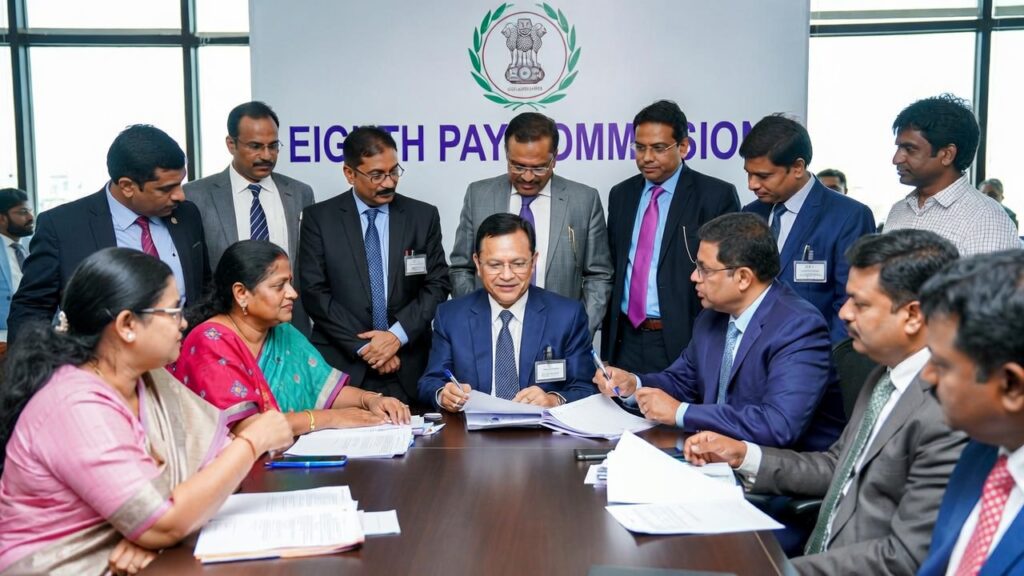
It benefits approximately 50 lakh central government employees (including defence personnel) and around 65–70 lakh pensioners. The commission, chaired by Justice Ranjana Prakash Desai, was formally constituted in late 2025 with an 18-month timeline to submit its report.
The effective date for revised benefits is widely expected to be January 1, 2026 — following the tradition of past commissions. This means any approved changes will likely apply retrospectively, with arrears paid once the recommendations receive Cabinet approval (possibly in 2027 or early 2028).
Key Expected Benefits for Government Employees
The most talked-about aspect is the salary hike, driven primarily by the fitment factor, a multiplier applied to the current basic pay to determine the revised amount.
Experts and reports project the fitment factor to fall in the range of 2.15 to 2.86, with some estimates as high as 2.57–3.0. This could translate to a 20–35% overall increase in take-home pay (after DA resets to zero upon implementation).
Here are some illustrative projections for entry-level employees (based on the current minimum basic pay of ₹18,000 under the 7th CPC):
- Fitment factor 2.28 → Revised basic pay ≈ ₹41,000 (≈34% increase)
- Fitment factor 2.57 → Revised basic pay ≈ ₹46,260
- Fitment factor 2.86 → Revised basic pay ≈ ₹51,480 (significant boost for lower levels)
Higher pay levels will see proportional increases, with allowances like HRA (which varies by city classification) and Transport Allowance recalculated on the new basic pay.
Read this: The National Education Policy (NEP) 2020
Other major benefits include:
- Revised allowances — Updated HRA, TA, special duty allowances, and potentially new performance-linked incentives.
- Better work-life perks — Possible enhancements in housing schemes, medical reimbursements, leave policies, and family support programs.
- Pension revisions — Minimum pension (currently ₹9,000) could rise to around ₹20,500 or more, providing stronger post-retirement security.
These changes aim to address real wage erosion due to inflation and improve overall financial well-being.
Timeline: What Happens in 2026?
- January 1, 2026 — Official effective date begins (arrears will accumulate from here).
- Early–mid 2026 — A modest DA hike (likely 2%, taking it to ~60%) may still apply under the 7th CPC structure as a bridge.
- Mid-2027 to early 2028 — Commission submits report → Government approves → Revised salaries/pensions roll out with arrears.
Until full implementation, employees continue under the existing 7th CPC pay matrix with bi-annual DA updates.
Why This Matters for the Economy and Employees
The 8th Pay Commission isn’t just about higher paychecks — it’s about restoring purchasing power, boosting morale, and stimulating consumption. Increased disposable income for millions could positively impact sectors like retail, housing, and consumer goods.
For government employees, especially those in lower pay levels, the revision promises meaningful relief after a decade of inflation pressures.
Final Thoughts
While the exact fitment factor and final figures are still under deliberation, the 8th Pay Commission signals the government’s commitment to fair compensation in a changing economy. Patience will be key — the real financial impact will unfold over the coming months and years, but the promise of substantial, long-overdue benefits makes 2026 a year of hope for lakhs of families.