Inclusive education is not only about bringing every child into the classroom. It is also about understanding each student’s needs and making sure they receive the right support at the right time.
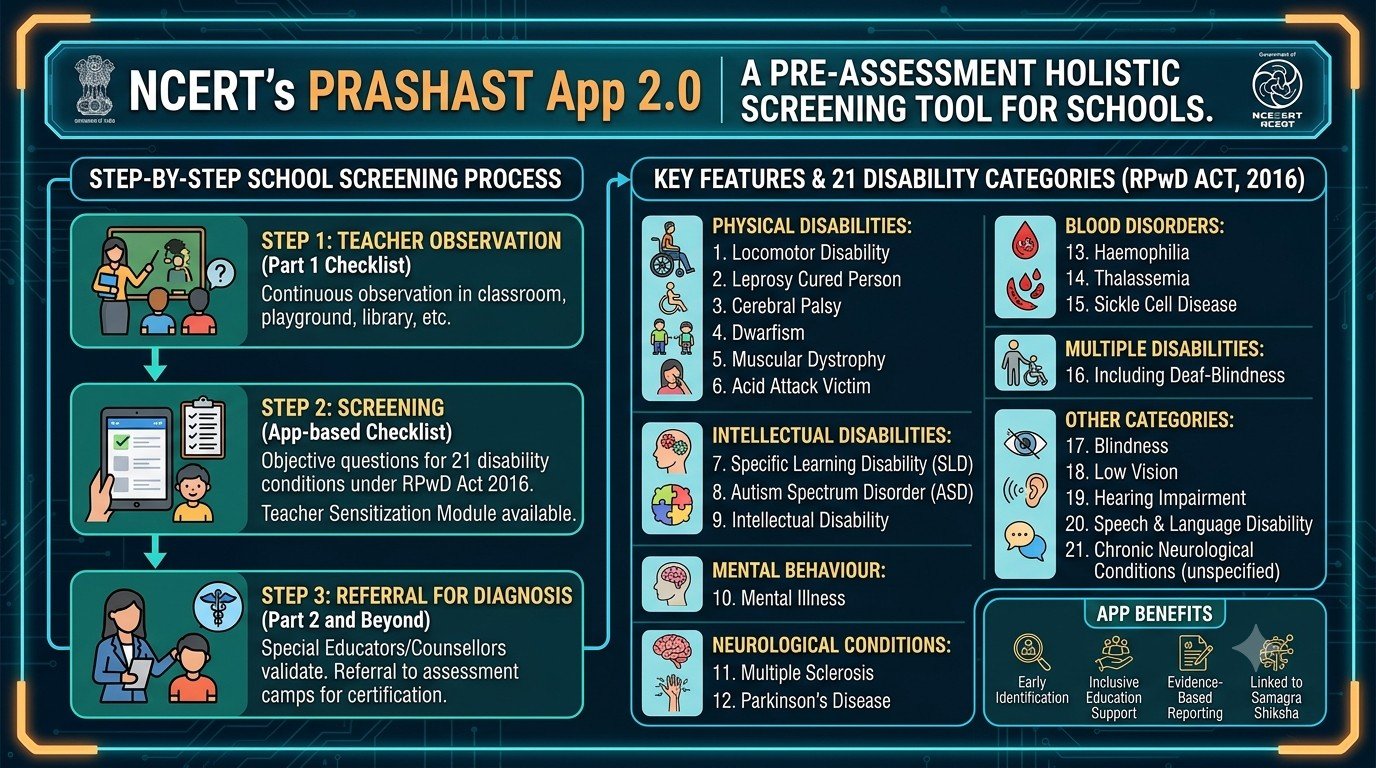
To support this approach, the Government of India has introduced PRASHAST, a school-based disability screening initiative designed to help identify children who may need further assessment and support. PRASHAST covers 21 disability conditions recognized under the Rights of Persons with Disabilities (RPwD) Act, 2016.
The updated PRASHAST App 2.0 provides a digital platform for schools to carry out this screening process in a structured manner.
What is PRASHAST App 2.0?
PRASHAST stands for a disability screening initiative developed to facilitate the early identification of children who may have disabilities.
The official PRASHAST platform describes it as a school-based screening tool covering 21 disability conditions. It uses a two-part process: the first level is carried out by regular teachers based on observable characteristics, while the second level involves special educators who validate observations and help determine the appropriate next steps.
The important point is that PRASHAST is a screening tool, not a medical diagnostic tool. A student identified through screening may need further professional assessment and, where appropriate, disability certification.
Why is PRASHAST important for schools?
Some disabilities are easily noticed, while others may remain hidden for years.
For example, a child may have difficulties related to learning, communication, behaviour, autism, hearing, vision, or other areas without the issue being immediately recognized as a possible disability.
Early screening can help schools:
- Identify students who may require additional support
- Recognize possible hidden disabilities
- Avoid misunderstanding a child’s learning or behavioural difficulties
- Refer students for further assessment when required
- Strengthen inclusive classroom practices
- Support appropriate educational interventions
NCERT explains that PRASHAST was developed to help regular teachers and special educators screen and tentatively categorize disability conditions at the school level before students are referred for further assessment and certification.
PRASHAST covers 21 disabilities
PRASHAST is based on the 21 disability conditions recognized under the RPwD Act, 2016. The screening framework includes areas such as physical, visual, hearing, speech and language, learning, autism, mental health, and other disability-related conditions.
This broad coverage is important because not every child with a disability will show the same signs. A school-based screening system helps teachers look at students more systematically rather than relying only on obvious physical characteristics.
| PRASHAST Pre-Assessment Holistic Screening Tool | Official Website |
| Khel Mahakumbh 2026 | Visit Here |
How does PRASHAST screening work?
The screening process is broadly divided into two parts.
Part 1 – Screening by regular teachers
The first level is intended for regular teachers.
Teachers use the prescribed checklist and their day-to-day observations of students to identify children who may show characteristics requiring further attention.
This is not about diagnosing a child. Instead, teachers record relevant observations using the screening framework.
The official PRASHAST resources describe Part 1 as the preliminary screening of students by regular teachers.
Part 2 – Validation by special educators
Students shortlisted after the first level can proceed to Part 2.
A special educator reviews and validates the observations made during Part 1 and helps categorize the concerns appropriately.
After the school-level process, students may be referred for further professional assessment and certification where required.
How can schools use PRASHAST App 2.0?
Schools can approach the process in a simple sequence.
Step 1: School onboarding
The school first needs to complete the required onboarding process on the PRASHAST platform.
School information and relevant details are entered and verified before screening activities begin.
Step 2: Complete required training
Teachers and other designated school personnel should complete the required PRASHAST training before starting screening activities.
The current official PRASHAST platform lists mandatory training as part of the implementation process.
Step 3: Conduct Part 1 screening
Regular teachers conduct the initial screening using the PRASHAST checklist.
Teachers should base their responses on their observations and the prescribed screening indicators rather than making medical assumptions about students.
Step 4: Identify students requiring further screening
Students whose responses indicate that additional examination may be required can be shortlisted for the next stage.
Step 5: Conduct Part 2 screening
The special educator conducts the second-level screening and validates the observations from Part 1.
Step 6: Referral for further assessment
Screening does not itself establish a disability certificate.
Where required, students are referred for assessment by the appropriate professionals or assessment camps. The purpose is to ensure that children who may need support do not remain unidentified.
Step 7: Support and monitoring
After identification and appropriate assessment, schools can work with parents, special educators, and other stakeholders to provide suitable educational support.
Monitoring student progress is also an important part of creating an inclusive learning environment.
Who is responsible for PRASHAST screening?
PRASHAST involves different stakeholders.
Headmaster or Principal
The school head plays an important role in coordinating implementation, ensuring that teachers are assigned appropriate responsibilities and that the school completes the required processes.
Regular Teachers
Regular teachers generally conduct Part 1 screening because they observe students regularly in classroom and school situations.
Special Educators
Special educators play an important role in Part 2 screening, validation, and further guidance for students identified through the initial screening.
Parents
Parents are important partners in the process. Communication between school and parents can help teachers better understand a child’s learning, development, and support requirements.
PRASHAST App 2.0 and digital screening
One of the major advantages of a digital platform is that it can make the screening process more organized and easier to monitor.
The updated PRASHAST initiative is designed around a structured digital workflow for schools. Current official information also describes integration with education-related digital systems and portals.
This can help move the process away from scattered paper-based records toward a more systematic approach to screening, referral, and monitoring.
Is PRASHAST a diagnostic test?
No.
This is one of the most important things teachers and parents should understand.
PRASHAST is designed for screening and preliminary identification. It does not replace a medical or professional disability assessment.
A student who is flagged during screening may require further assessment by qualified professionals. NCERT’s PRASHAST booklet specifically describes the school-level process as a step before referral for assessment and certification.
Therefore, teachers should avoid telling a student or parent that the child “has a disability” solely based on a PRASHAST screening result.
Benefits of PRASHAST App 2.0
The initiative can provide several benefits to schools and students:
Early identification: Possible signs of disability can be noticed earlier.
Better classroom support: Teachers can become more aware of individual learning needs.
Focus on hidden disabilities: Conditions such as specific learning disability and autism may otherwise go unnoticed.
Structured screening: A common checklist provides a more systematic approach.
Better referral: Students requiring additional assessment can be referred through the appropriate process.
Inclusive education: Early identification can contribute to a more inclusive school environment.
NCERT identifies PRASHAST as one of its initiatives supporting equitable and inclusive education.
Important points for teachers
Teachers should keep a few things in mind while using PRASHAST:
- Do not diagnose students yourself.
- Base observations on the prescribed PRASHAST indicators.
- Maintain student privacy and handle information responsibly.
- Avoid labelling or embarrassing students.
- Communicate sensitively with parents.
- Refer students for further assessment when required.
- Remember that every child has different learning needs.
- Use screening results to support the child, not to stigmatize them.
PRASHAST 2.0: Official timeline for 2026
The current official PRASHAST platform lists an implementation timeline that includes training, school onboarding, Part 1 screening, Part 2 screening, intervention, monitoring, and outcome evaluation. The listed dates include 1 September 2026 for school onboarding and Part 1 screening, 2 October 2026 for Part 2 screening, and subsequent intervention, monitoring, and outcome evaluation stages. Schools should always check the official portal for the latest schedule and instructions because implementation requirements can change.
PRASHAST App 2.0 login
The official PRASHAST portal provides role-based access for users. Its tutorial page shows teacher login using the school’s UDISE Code and the mobile number linked with the UDISE+ system, along with OTP verification.
Teachers and school officials should use the official PRASHAST platform rather than relying on unofficial websites or third-party login pages.
Final Words
PRASHAST App 2.0 is an important step toward making school education more inclusive. By bringing systematic disability screening into schools, it can help teachers identify students who may need additional attention and support.
However, screening should always be viewed as the beginning of the support process, not a final diagnosis. The real goal is to understand every child’s needs, connect them with appropriate professional support, and create a classroom where every student has an opportunity to learn and participate.
For official information, resources, tutorials, and updates, schools should refer to the Government of India’s PRASHAST portal and NCERT resources.
Frequently Asked Questions (FAQs)
PRASHAST App 2.0 is a digital school-based screening platform designed to facilitate screening of students for 21 disability conditions.
PRASHAST covers 21 disability conditions recognized under the RPwD Act, 2016.
Part 1 is conducted by regular teachers using the prescribed screening checklist.
Part 2 is conducted by special educators for students identified through the initial screening.
No. It is a screening mechanism. Further professional assessment and certification may be required.
PRASHAST is primarily a school-based screening initiative involving schools, teachers, and special educators.
Schools should use the official PRASHAST portal and NCERT’s official resources for current instructions, training material, and updates.